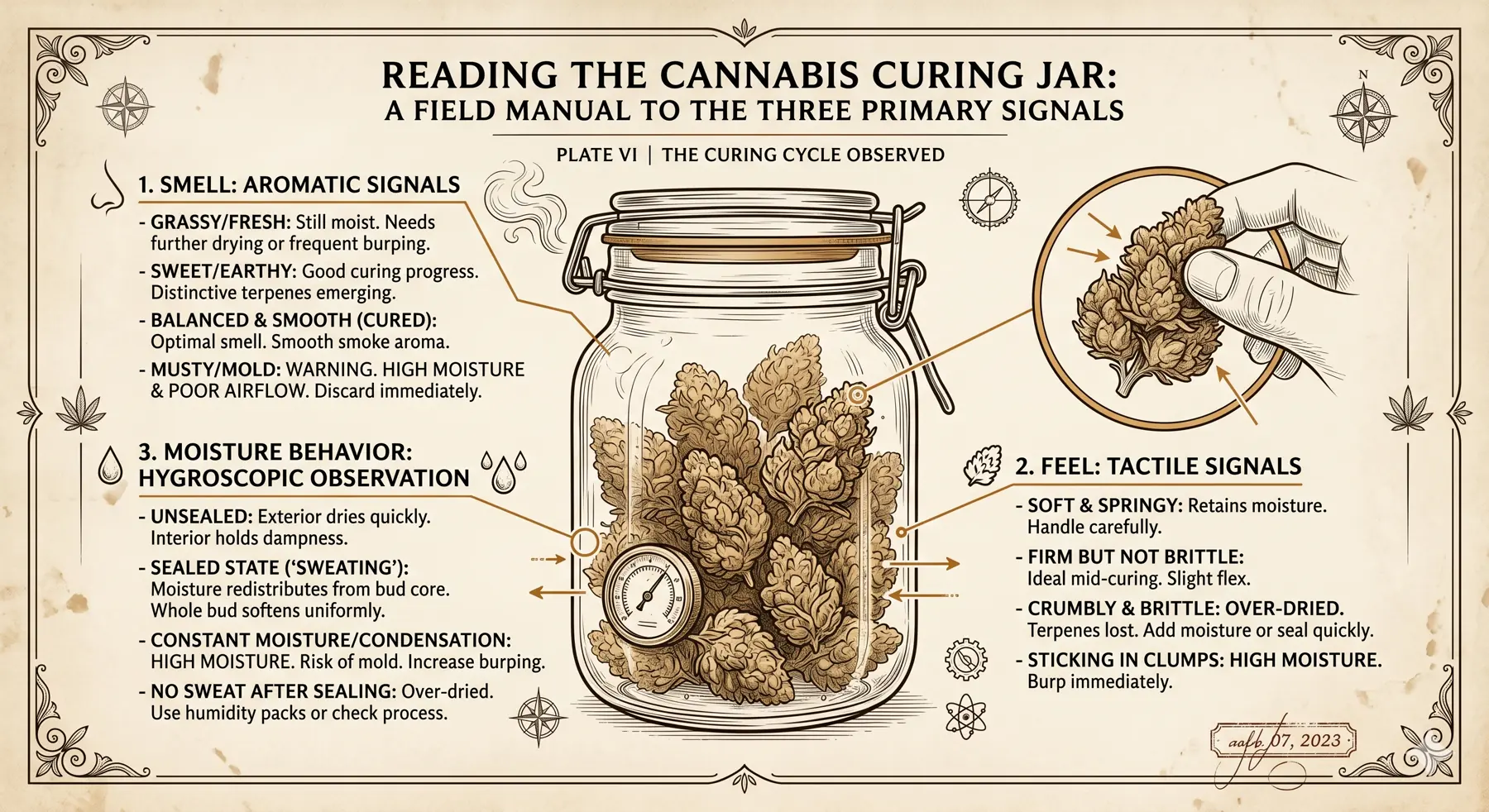
Curing quick answer

What Is Curing?

Curing is the post-drying stage where cannabis rests in sealed jars or another controlled container so the remaining moisture can redistribute slowly through the flower. The point is not to keep drying forever. The point is to let the flower settle into a cleaner, calmer finish with better aroma, smoother texture, and more stable jar behavior than it had on day one after drying.

This is where a good run either starts sounding finished or starts revealing that the dry was never as clean as it looked. Curing is not magic and it is not decoration. It is a moisture-management stage that protects the final result if the handoff into jars was honest.

What it is A slow post-drying settling stage for jar-ready flower.
What it does Helps moisture even out while aroma and texture get cleaner.
Main failure Starting the cure with flower that was never truly ready for jars.
What it means

Curing is the stage after drying where the flower stops shedding obvious surface moisture and starts balancing itself more gently.

Searchers asking what curing is usually want a definition, but the useful definition includes the job curing is supposed to do. Curing begins after drying, once the flower is ready to leave the open-air stage and move into jars. Instead of trying to strip out all remaining moisture, the cure slows the process down. That slower pace gives the inside and outside of the flower time to even out while the jar keeps the environment readable enough to monitor.

That is why curing belongs beside the dry, not instead of it. Drying removes the obvious external moisture and gets the flower to a safe handoff point. Curing is what happens after that handoff if the buds are stable enough to sit in a container without turning dramatic. If you already know the definition and need the operating steps, jump to curing cannabis. If you need the failure patterns, use curing cannabis mistakes. This page stays narrower: it answers what curing is, what it is trying to accomplish, and why it matters to the final finish.

A good cure does not feel chaotic. The jar should get quieter over time. Aroma should become cleaner. The feel of the flower should become more even. If the cure feels like a constant rescue project, the problem is often not the definition of curing. The problem is that the flower entered the jar too wet, too dry, or too unstable to settle well.
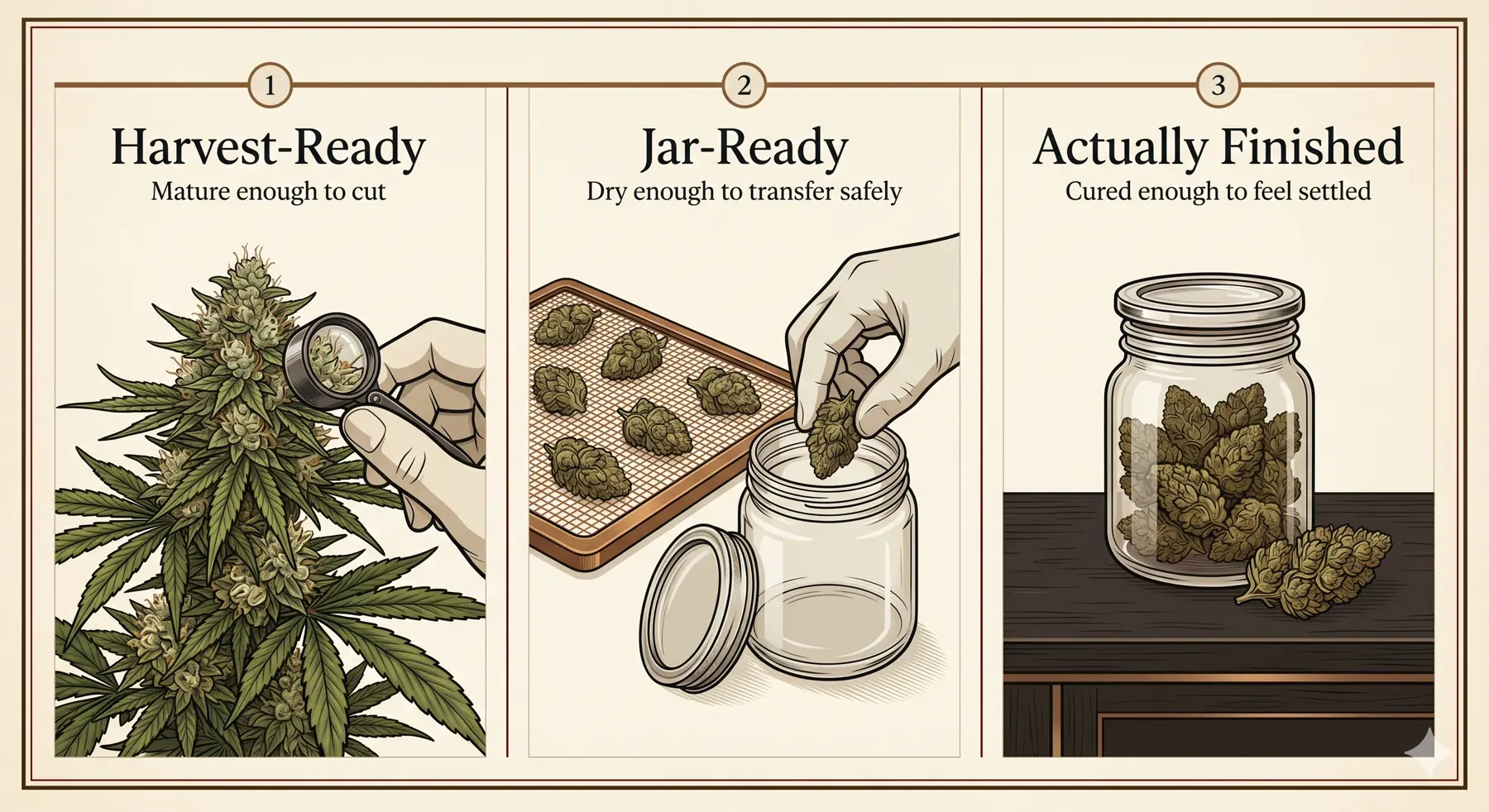
Short version

Curing is the slow post-drying reset that lets the jar become calmer instead of louder.

  • It starts after drying, not before.
  • It depends on a clean handoff into jars.
  • It protects finish quality through slower moisture balancing.
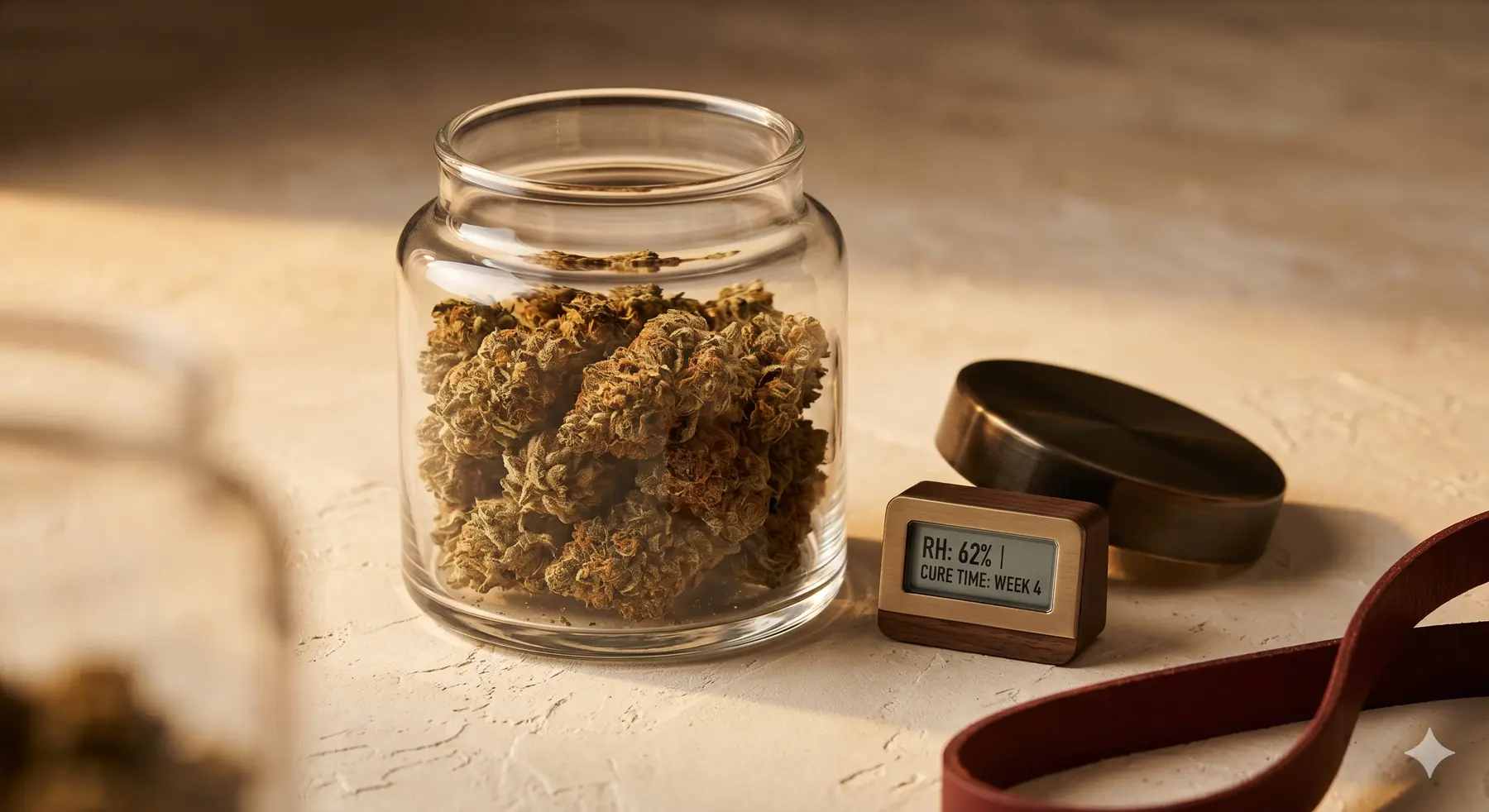
Glass curing jar with dried cannabis flower, lid, and hygrometer arranged on a clean work surface for a post-drying inspection.
A cure starts after the flower is jar-ready. The container is there to hold a readable environment, not to hide a bad drying call.
Why it matters in a compact grow

Compact grows make the finishing stage more honest because there is less room to hide bad habits.

In a compact grow, the same discipline that keeps the canopy readable should carry through the finish. Small-space growers do not have the luxury of turning harvest and cure into a messy side project that lives in another room and gets checked randomly. That makes curing more important, not less. The final quality in a compact setup depends on whether the grower can close the loop from plant to jar with the same level of control they used in the grow itself.

A contained workflow also makes curing easier to evaluate. Smaller batches are easier to compare, easier to recheck, and easier to keep inside a consistent routine. That matters because the cure is really a reading exercise. You are reading moisture behavior, smell, and texture at the same time. If those signals are being checked in a calm workflow, the cure becomes useful. If they are being checked in a hurry, the jar starts reflecting stress instead of craft.

This is why the finish cluster belongs next to the rest of the compact system. The flower you just harvested from an indoor cannabis grow system still has one of the most important decisions left. If the run has been planned around a contained, craft-first workflow, the cure should feel like the controlled final stage of that process, not an afterthought you improvise on the kitchen counter.

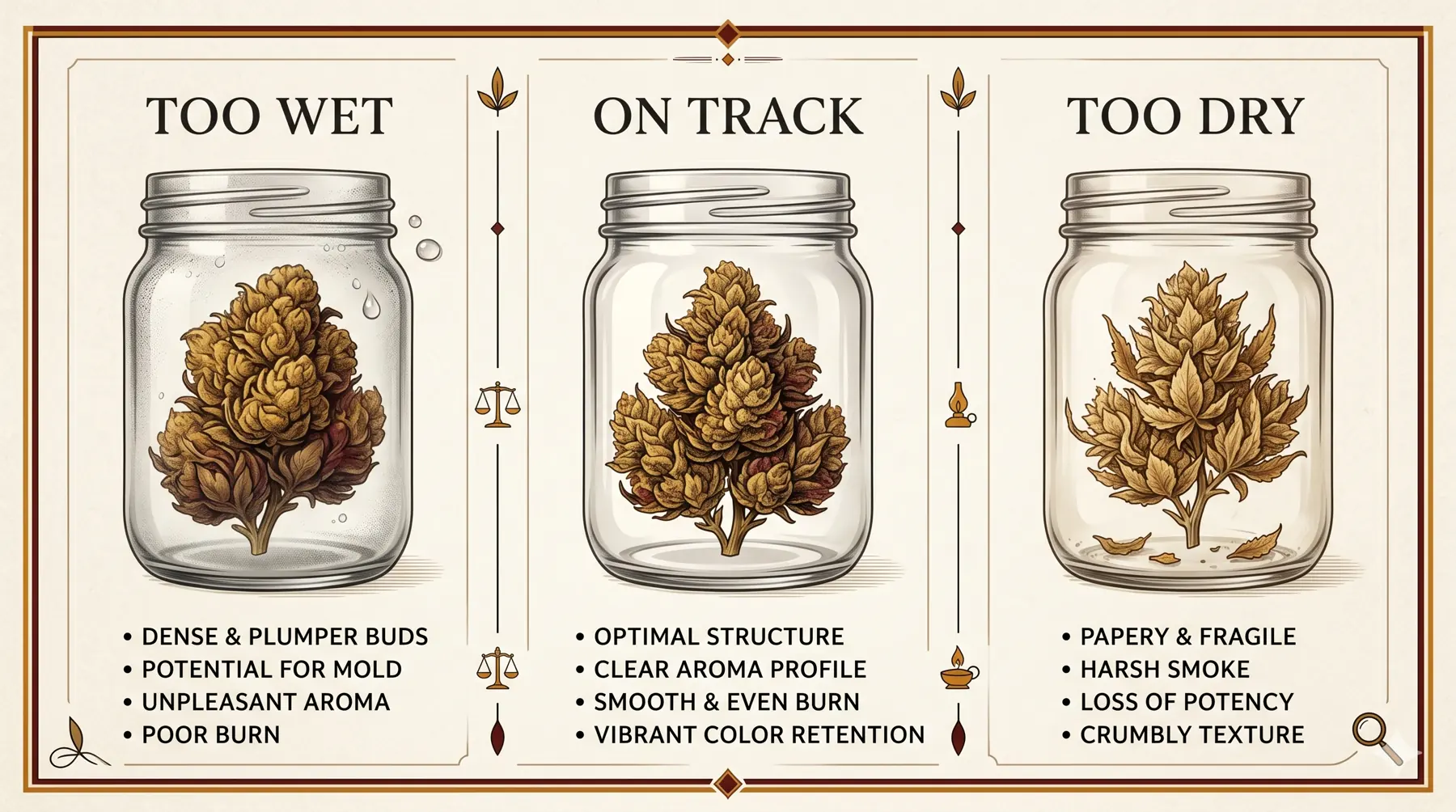
Educational curing state board comparing jars that are too wet, on track, and too dry after the drying-to-cure handoff.
The cure is easiest to understand when the jar is read in simple states: too wet, on track, or too dry.
Decision layer

Curing only works when the flower enters the jar in a range the jar can manage quietly.

If you think curing means Better interpretation Why that matters
Keep drying in a jar Let the flower settle after the main drying work is already done. Jars are for controlled finishing, not for hiding a wet center that should still be drying.
Open the lid on a ritual schedule Read the jar and respond to its behavior. Curing gets cleaner when moisture decisions come from actual signals, not habit alone.
Time automatically fixes everything Time helps only when the handoff into cure was sane. If the buds were jarred too early, the cure becomes a moisture problem with a lid on top.
The cure starts at harvest The cure starts after drying and after the buds are truly ready for jars. That is why when are buds ready for jars is such an important companion page.

Put another way, curing is a transition stage. If the transition is too early, the jar turns noisy. If it is too late, the flower can enter cure flatter and less forgiving than it should. If you want the longer risk list, move next into curing cannabis mistakes and drying cannabis mistakes. Those pages explain how the handoff goes wrong. This page is the definition layer that makes those mistakes easier to recognize.

Where DWC or VGrow fits

DWC and cabinet-style systems do not change what curing is, but they do shape how cleanly a grower arrives there.

A DWC or VGrow-style workflow ends in the same finish questions every other grow must answer: Is the plant ready to cut, are the buds ready for jars, and is the cure settling cleanly? The method does not rewrite the cure. What it can do is create a more contained, more readable path into that stage. When the whole run has been managed with tighter observation, the grower usually arrives at harvest and cure with better context and fewer hidden surprises.

That matters in small systems because finish quality often becomes the real difference between a run that only looked good in flower and a run that actually finishes well. Hardware pages like the Vivosun VGrow DWC guide and workflow pages like compact craft cannabis grow are not cure guides by themselves, but they help explain why the finish stage should still feel deliberate inside a contained setup.

The cure is also where the compact-craft philosophy either becomes real or gets exposed. A grower can run a tidy cabinet, manage roots well, and still lose some of the finish by rushing jars. That is why curing belongs in the same quality conversation as root health, harvest timing, and room readability. It is not a side note. It is part of the same craft chain.

Dry-to-cure handoff diagram showing cannabis buds moving from drying checks into jar-ready status with notes for compact small-batch workflow.
The handoff into cure should feel like a clean workflow transition: dry first, jar second, then read what the jar is telling you.
Common mistake

The most common curing mistake is treating the jar like a rescue room for flower that was not ready to be there.

Growers often talk about curing as if it can correct almost any finish-stage problem. It cannot. The cure can refine a decent handoff. It cannot quietly absorb flower that is still too wet inside, already too brittle, or being handled constantly without a coherent reason. The jar tells the truth fast. If humidity rebounds hard, the smell stays swampy, or the buds feel noticeably wetter after sealing, the problem is usually earlier than the cure.

Another common mistake is turning a simple finishing concept into ceremony. Lids get opened on autopilot, humidity gets checked without context, and the flower gets handled more because the grower is nervous, not because the jar is actually sending a clear warning. A good cure should become less dramatic over time. If the jar keeps needing more theater, something upstream is still unsettled.

What to avoid
  • Starting cure before the buds are genuinely ready for jars.
  • Assuming the cure is just "more drying" in a different container.
  • Burping by ritual instead of reacting to real moisture behavior.
  • Overhandling the flower until it drifts drier in the name of caution.
  • Trusting one gadget more than the combined read of smell, feel, and jar behavior.
Practical takeaway

Curing is the slow, controlled finish stage that protects flower quality after drying if the jar starts from a stable handoff.

The short definition is enough to remember: curing is what happens after drying when jar-ready flower rests so moisture can redistribute slowly and the finish can settle. The better definition is operational: curing is only useful when the grower can read the jar honestly and stop using it as a place to hide earlier uncertainty.

01 Dry first

Do not call it curing until the buds are actually ready to leave the drying stage.

02 Jar with intention

Use a controlled container to hold a readable environment, not to rush closure.

03 Read the signals

Watch for calmer moisture behavior, cleaner aroma, and more even flower feel over time.

04 Protect the finish

Let the cure refine the result instead of turning it into a constant intervention routine.

If you came here asking what curing is, the best next move is to connect the definition to the rest of the finish chain. Use how to cure cannabis for the full process, common curing mistakes for failure patterns, when are buds ready for jars for the handoff question, and cannabis guide search if you need to widen the question from jars back into the whole grow. The definition page should make those next clicks clearer, not replace them.

Compact finishing timeline showing drying, jar handoff, curing, and final settled flower stages in a small-batch workflow.
The cure is not a separate art form. It is the final controlled stage in the same workflow that grew, finished, and dried the flower.
FAQ

Questions people usually mean when they ask what curing is.

Is curing the same as drying?

No. Drying removes obvious external moisture before the buds are ready for jars. Curing starts after that, when the flower is stable enough to rest in a container and finish more slowly.

Why does curing matter so much for final quality?

Because the finish does not stop at harvest. A clean cure helps moisture settle more evenly and supports a cleaner aroma, smoother texture, and more stable jar behavior than a rushed handoff can deliver.

Can a jar fix flower that was too wet when it was packed?

Not in the way people hope. A jar can hold a stable environment, but it cannot quietly correct a handoff that was obviously too wet. That usually creates louder jar behavior instead of better curing.

Does curing matter in a compact or cabinet grow?

Yes. Small-batch and compact workflows often make finish quality more visible, so the cure matters even more. A contained grow still depends on a controlled drying-to-jar transition.